Negative Air Machine vs. HEPA Air Scrubber: Key Differences
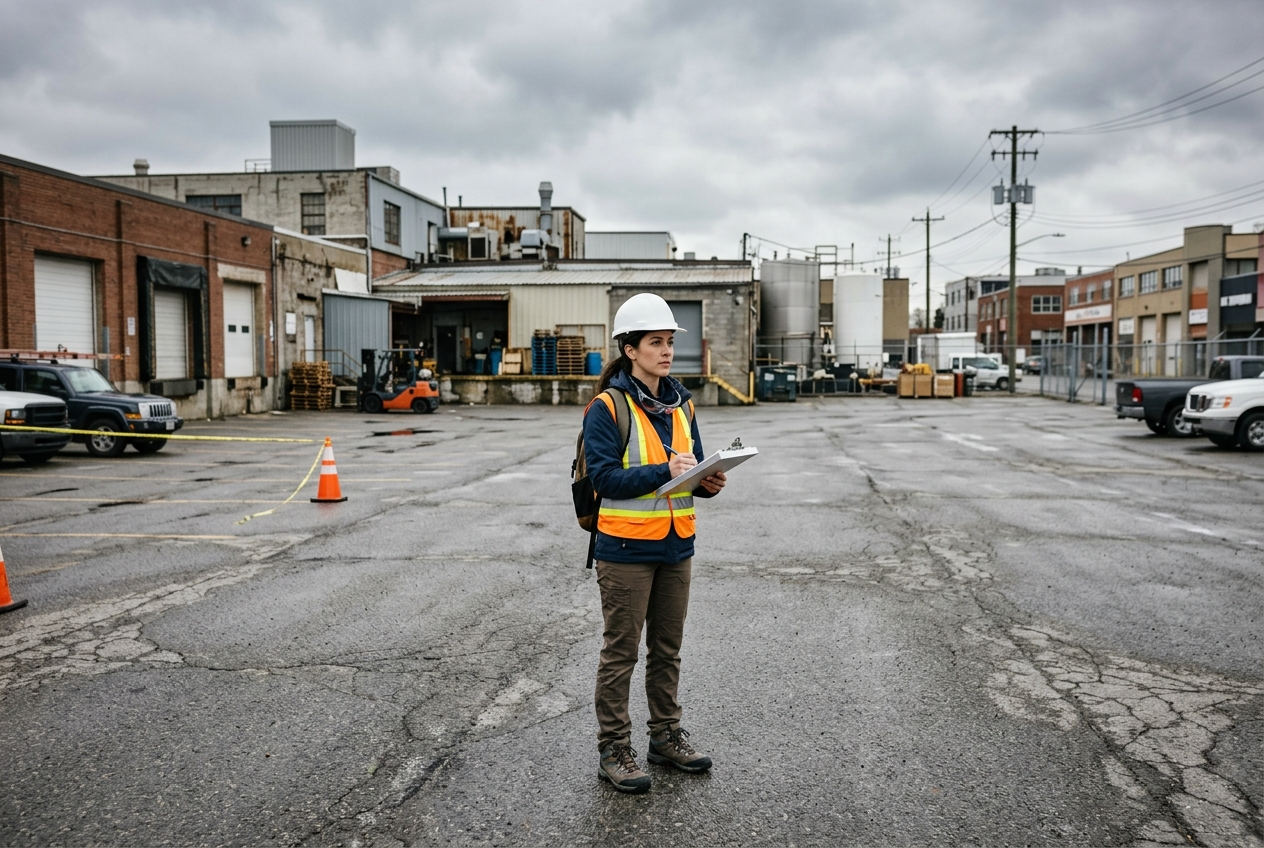
Contractors, facility managers, and remediation crews often use "negative air machine" and "air scrubber" interchangeably. They are not the same, and treating them as such can compromise a containment plan before the first barrier goes up. One machine controls pressure. The other cleans the air already inside a space, and confusing the two on a mold remediation, an asbestos abatement, or a healthcare renovation project can mean the difference between a compliant containment and a real exposure event.
This guide breaks down what each machine does, where their functions overlap, and how to choose the right one for containment, indoor air quality, and regulatory compliance across remediation, healthcare, and construction projects.
Key Takeaways
- A negative air machine establishes negative pressure and exhausts filtered air outside the containment, reducing the movement of airborne contaminants into occupied spaces.
- A HEPA air scrubber recirculates and filters air within a space; it does not, on its own, create negative pressure.
- Regulated jobs like asbestos abatement and mold remediation over 100 square feet typically require negative pressure containment, not filtration alone.
- Air scrubbers suit general indoor air quality improvement, dust control, and odor reduction in occupied or semi-occupied spaces.
- Choosing the wrong equipment for a regulated project can undermine compliance even when every other step is done correctly.
Understanding Air Filtration and Containment Systems
Air filtration keeps workers and building occupants from breathing what a project disturbs. Every remediation, healthcare, or construction site touching contaminated material needs a plan for where the released particles go, and HEPA filtration is the backbone of that plan: a true HEPA filter captures at least 99.97% of particles at 0.3 microns, the hardest size to filter, and shows up in nearly every serious airborne contaminant effort, from mold remediation and asbestos work to healthcare isolation rooms. Where these systems differ is not the filter, but what happens to the air afterward, and whether the space ends up under negative pressure or simply cleaner.
What Is a Negative Air Machine and How Does It Work?
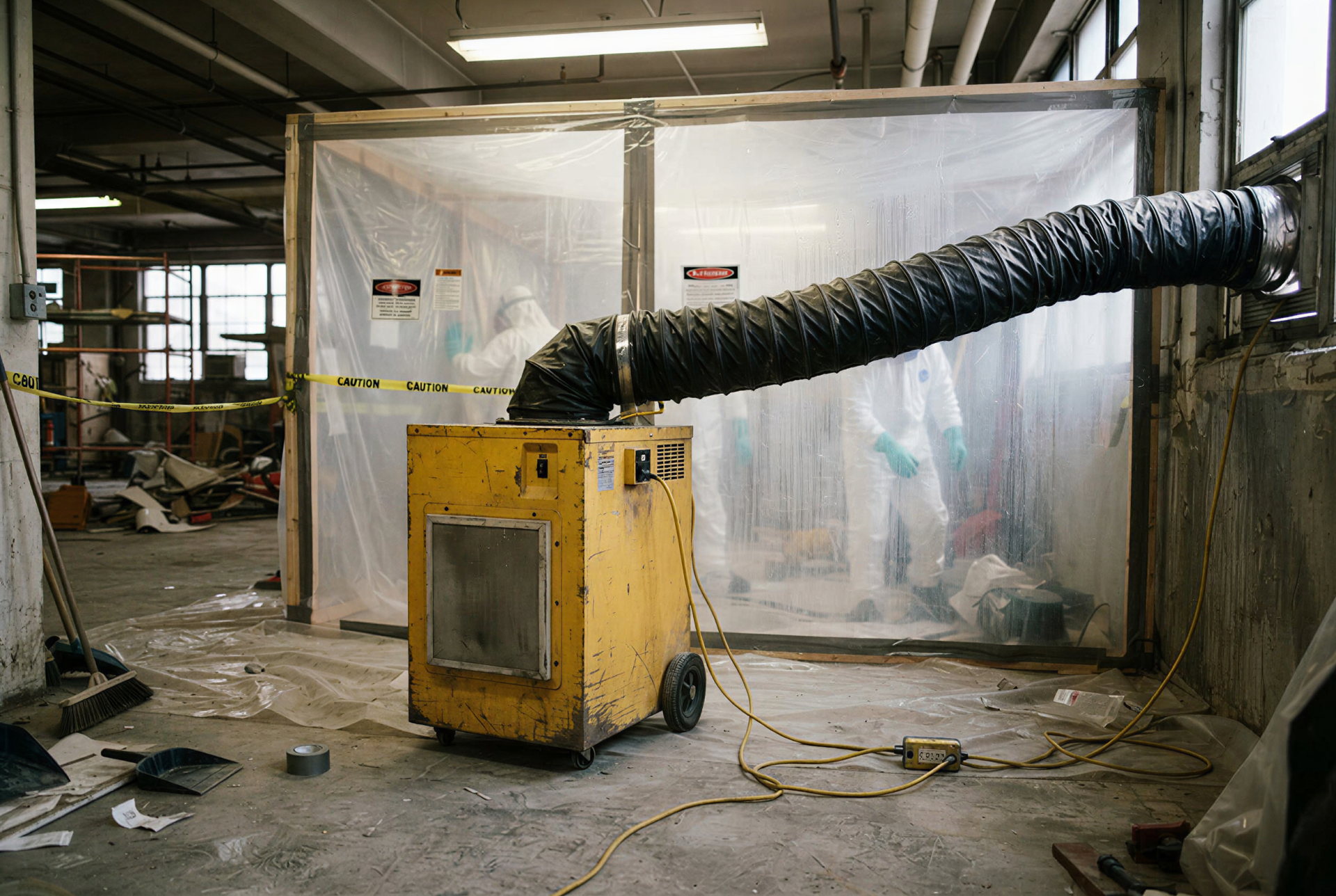
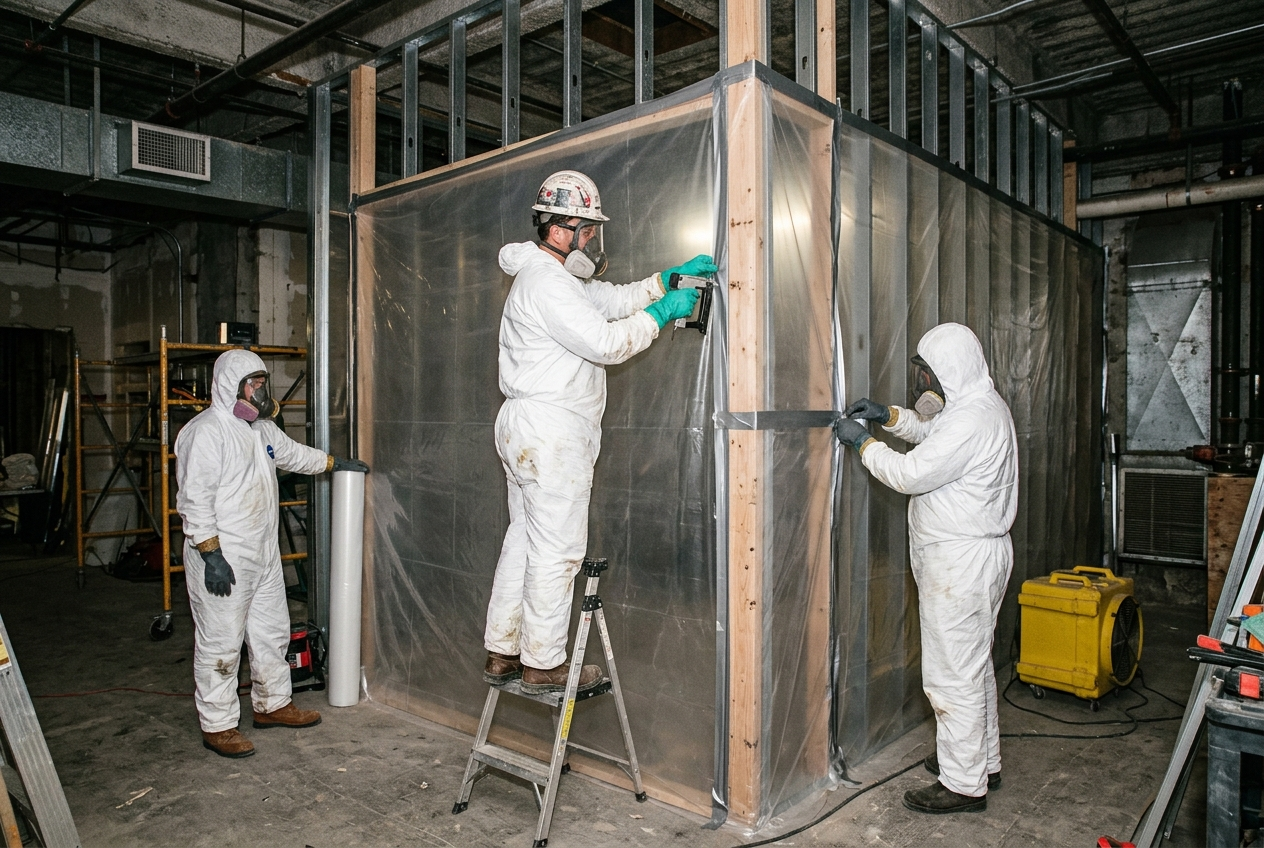
A negative air machine draws air from inside a containment area, passes it through a HEPA filter, and exhausts it outside, typically to the building's exterior. Removing more air than enters the space creates negative pressure relative to the surroundings, so air pulls in through small gaps rather than pushing out.
OSHA's asbestos standard spells this out for negative pressure enclosures: they must maintain a measurable pressure differential, with air directed away from workers and toward the HEPA filtration or a collection device. Worth being precise here: negative pressure reduces the escape of particles through gaps and seams. It does not, by itself, stop particles from moving out the moment a door opens, a separate problem anterooms address, covered further on.
Primary Applications of Negative Air Machines
Negative air machines show up most often on asbestos abatement, where OSHA's construction standard treats a properly built and tested enclosure as an accepted control method. Mold remediation over 100 square feet and lead paint removal follow the same logic: contain the area, hold it under negative pressure, filter the exhaust. In healthcare settings, they support isolation rooms and construction containment inside occupied facilities, where the patient population next door may be immunocompromised, keeping disturbed particulate from reaching adjacent corridors and patient care areas.
What Is a HEPA Air Scrubber and How Does It Work?
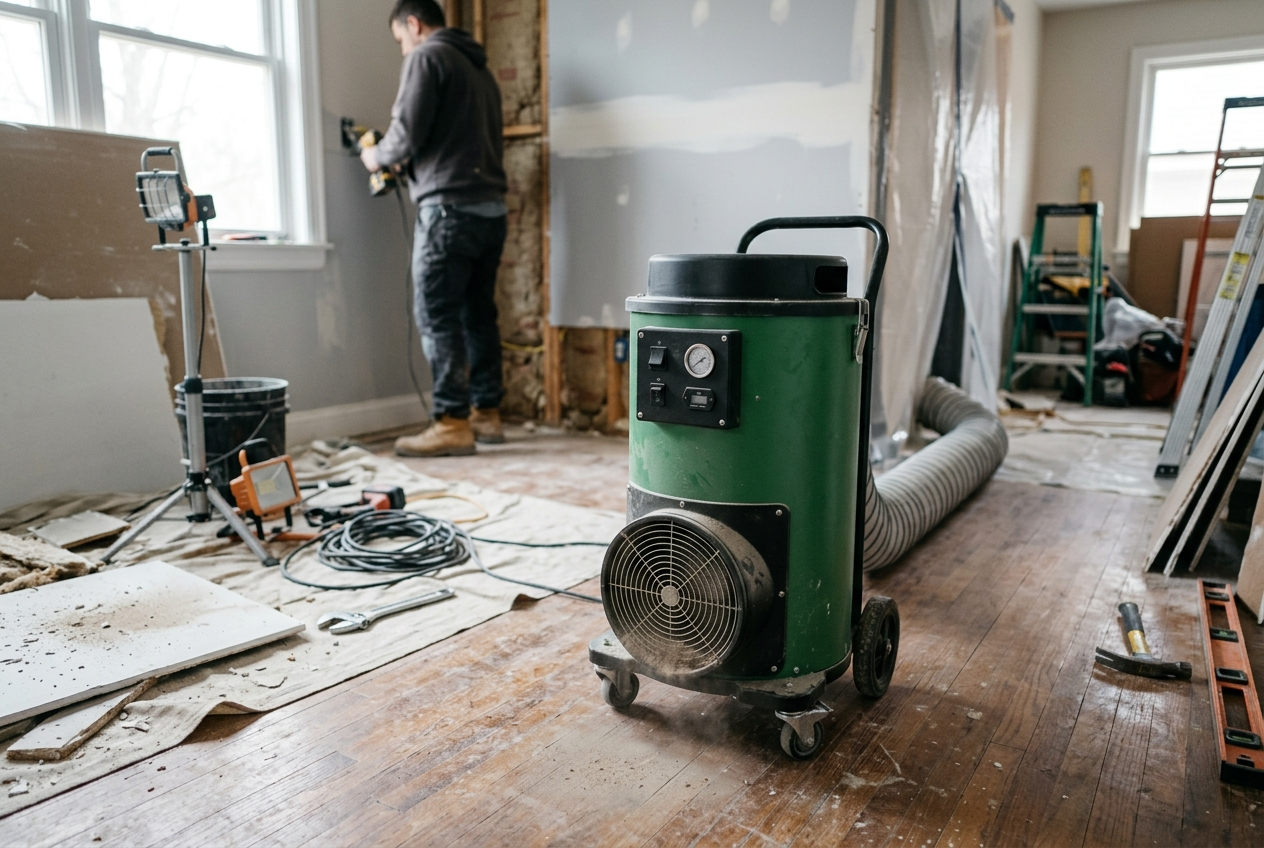
An air scrubber pulls air from a space, filters it through a HEPA filter (often paired with a pre-filter and sometimes a carbon filter for odor), and returns the filtered air to the same space. It is a recirculating system, not an exhaust system.
That recirculation is the functional difference. The HEPA filter is the same underlying technology whether it sits in a negative air machine or a scrubber, capable of removing at least 99.97% of particles at 0.3 microns, per EPA's definition. What changes is where the filtered air goes afterward: a scrubber recirculates rather than exhausting, so it cleans a room's air without necessarily creating negative pressure. Some units can be configured to exhaust outside, but that's a configuration choice, not the default.
Primary Applications of Air Scrubbers
Air scrubbers do well in post-construction cleanup, clearing fine dust from a finished space rather than maintaining active containment. They are also common for odor control after water damage or smoke events, and general indoor air quality improvement where full containment is not practical. Because they do not require exhaust ductwork to the outside, they are flexible to deploy: a renovated wing reopening to patients, an office floor after a water event, or a construction zone waiting for dust to settle before occupants return.
Negative Air Machine vs Air Scrubber: Key Differences
| Feature | Negative Air Machine | HEPA Air Scrubber |
|---|---|---|
| Primary Purpose | Containment and pressure control | Air purification and filtration |
| Creates Negative Pressure | Yes | No (unless configured specifically) |
| Airflow Direction | Exhausts air outside containment area | Recirculates filtered air |
| Regulatory Applications | Commonly required | Typically supplemental |
| Contaminant Control | Reduces contaminant migration | Reduces airborne particles |
| Typical Industries | Remediation, healthcare, abatement | Construction, restoration, IAQ |
| Installation Requirements | More complex | More flexible |
| Compliance Role | Critical in regulated projects | Supportive air quality measure |
The two are often used interchangeably because they share the same core filtration technology, and because contractors sometimes press one into service for the other's job. But the differences in airflow direction and pressure control determine whether equipment satisfies a regulatory requirement or simply cleans the air in a room. Choosing the wrong one on a compliance-driven project does not always announce itself right away: a scrubber running inside a mold containment might make the air feel cleaner while the containment never establishes negative pressure, which may only be noticed when someone measures it.
Similarities Between Negative Air Machines and Air Scrubbers
Both machines rely on HEPA filtration to capture airborne particles and reduce exposure for workers and occupants. On many restoration projects, both end up on site at different stages of the same job, which is part of why the terminology gets muddled even though the distinction is functional, not visual.
When Should You Use a Negative Air Machine?
Hazardous Material Remediation
Asbestos, lead, and mold containment above certain size thresholds call for negative pressure, not filtration alone. EPA's mold remediation guidance describes maintaining containment under negative pressure with a HEPA-filtered fan exhausted outside the building, keeping contaminated air from migrating into adjacent spaces. Expectations here typically include documented pressure readings, not just a running machine.
Healthcare and Infection Control
Airborne infection isolation rooms depend on negative pressure to keep contaminants from spreading into adjacent patient care areas. CDC guidance calls for HEPA filtration at 99.97% efficiency and recommends an anteroom where isolation is required, since pressure alone does not stop particle movement the moment a door opens.
High-Risk Containment Projects
Any project where contaminant migration into an adjacent occupied space carries real consequences — patient exposure, cross-contamination, worker exposure — calls for a negative air machine rather than a scrubber. These typically carry documentation requirements too: pressure logs, inspection records, and verification that the equipment performed as intended.
When Should You Use an Air Scrubber?
Dust and particulate control during occupied renovations is a natural fit for a scrubber, since the goal is cleaner air in a space people are actively using, not a sealed containment. The same goes for odor removal and post-restoration cleanup, once the work itself is finished.
General indoor air quality improvement, the kind EPA's guidance on portable air cleaners addresses, calls for scrubbers rather than negative air machines. EPA notes filtration works best as a supplement to source control and ventilation: a jobsite scrubber cleans the air that's there without addressing what's producing the contamination. That's where scrubbers do their best work: a wing waiting to reopen, a room recovering from a minor water event.
Can One Machine Perform Both Functions?
| Scenario | Negative Air Machine | Air Scrubber |
|---|---|---|
| HEPA Filtration | Yes | Yes |
| Air Cleaning | Yes | Yes |
| Negative Pressure Creation | Yes | No |
| Recirculating Air Cleaning | Possible | Yes |
| Containment Projects | Ideal | Limited |
| General IAQ Projects | Effective | Ideal |
Some units can be configured for dual functionality, ducted to exhaust outside for negative pressure when containment matters, or set to recirculate for air cleaning in an occupied space. But a unit built for recirculation rarely has the exhaust capacity to reliably hold negative pressure on a regulated project. Match the equipment to the requirement, not the requirement to whatever is on the truck.
Regulatory and Safety Considerations
OSHA's asbestos standard and EPA's mold remediation guidance both specify containment and pressure requirements for regulated work, with industry-specific standards layered on top depending on the material and setting. Equipment selection isn't a matter of preference; it's what determines compliance. Documentation matters just as much. Pressure readings, inspection logs, and filter change records demonstrate that a containment performed as designed, and wasn't just set up and abandoned. A professional EHS assessment before work begins catches gaps standard practice might miss.
Factors to Consider Before Choosing Equipment
| Consideration | Negative Air Machine Priority | Air Scrubber Priority |
|---|---|---|
| Containment Needs | High | Low |
| Indoor Air Quality Improvement | Medium | High |
| Regulatory Compliance | High | Medium |
| Occupied Spaces | Medium | High |
| Hazardous Material Presence | High | Low |
| Project Cost Considerations | Moderate | Moderate |
Containment needs and the presence of hazardous material point toward a negative air machine; indoor air quality improvement and occupied-space work point toward a scrubber. Regulatory compliance sits in between, weighted toward containment equipment on regulated projects, and cost tends to land in similar territory for both, so it rarely settles the decision on its own.
Common Mistakes When Selecting Air Quality Equipment
Choosing equipment based solely on airflow ratings is a common error. A high-CFM unit guarantees it moves a lot of air, not that it delivers the negative pressure or filtration efficiency a project needs. Assuming all HEPA-equipped units perform identical functions is another, since two machines with the same filter rating behave very differently depending on whether that air exhausts outside or recirculates. Overlooking containment requirements, and failing to calculate room size and air changes per hour before selecting equipment, round out the list. These are mistakes that tend to surface only once someone measures the space.
The Role of Professional EHS Guidance
Complex remediation and containment projects benefit from expert oversight because the difference between a containment that looks right and one that performs correctly in the field is often invisible without the right measurement tools. Risk assessments and exposure control strategies close that gap before it becomes a big, mid-project problem. Training matters just as much: a crew that understands why a containment is built the way it is, not just how to assemble it, catches a failing seal or a scrubber running in place of a negative air machine before it becomes a compliance issue.
Why Organizations Trust Higgins & Associates
Higgins & Associates has provided environmental, health, and safety consulting since 1996, with a focus on the regulatory compliance, training, and risk management that complex remediation and healthcare projects require. That experience comes from direct fieldwork. We test containment systems, monitor air quality on active jobsites, and investigate what happens when contaminant migration goes wrong.
For teams weighing equipment decisions, containment design, or broader environmental risk on a project, our EHS consulting services cover assessment, planning, and field verification from the ground up.
Conclusion
A negative air machine and a HEPA air scrubber share the same core filtration technology, and almost nothing else that matters for compliance. One manages pressure and exhausts contaminated air outside a containment; the other cleans the air inside a space without necessarily touching the pressure relationship at all.
The right choice depends on what the project requires: containment obligations, regulatory standards, and the consequences if contaminant migration goes unmanaged. Where those stakes are real, that decision is worth confirming with someone who can verify performance in the field, not just on paper.
If your team is planning remediation, healthcare, or construction work involving airborne contaminant control, reach out to our team to think through the right equipment and containment approach. You can also explore our full range of EHS services, or visit our homepage for an overview of our work.
FAQs
Is a HEPA filter required in every negative air machine application?
Not by definition, but in practice nearly every negative air machine used in regulated work incorporates HEPA filtration, since that's what makes the exhausted air safe to release.
How many air changes per hour should a negative air machine provide?
It depends on the project, the contaminant, and the applicable regulatory standard. That number should come from the governing standard, not a general rule of thumb.
Can air scrubbers remove chemical fumes and VOCs?
A standard HEPA filter captures particles, not gases. Removing fumes or VOCs requires a scrubber with an activated carbon or other gas-phase filter added to the HEPA stage.
What size negative air machine is needed for a containment area?
Sizing depends on the containment's volume and the air changes per hour required, not a fixed unit size. A qualified assessment of the space determines the right capacity.
How often should HEPA filters be replaced in air quality equipment?
It depends on use intensity and contaminant load. Filters running continuously on an active site need far more frequent inspection than one on occasional maintenance duty.